
Open source, long-term viability and vendor independence
How does Vates reduce vendor risk? Discover how its open-source model and support-driven strategy ensure long-term continuity and true infrastructure independence.


As organizations continue to lean on virtualization, cloud infrastructure, and backup technologies for critical operations, long-term continuity and vendor reliability have become increasingly important factors in infrastructure decisions.
For public administrations, regulated industries, and enterprise environments, virtualization platforms are expected to remain operational and maintainable over many years, regardless of market shifts, licensing changes, or organizational evolution. This is especially true for organizations operating long-lived on-prem or private cloud infrastructure.
This is where open source fundamentally changes the equation.
At Vates, continuity is built directly into the architecture, licensing model, and operational philosophy of the stack itself. Through open source technologies like XCP-ng and Xen Orchestra, organizations retain permanent access to the software they operate, while preserving the ability to maintain, adapt, audit, and support their infrastructure independently if needed.
Combined with a business model centered on long-term operational support rather than software lock-in, this creates a different approach to infrastructure resilience and vendor risk.
In this article, we’ll explore how Vates approaches these challenges in practice and why open infrastructure is increasingly viewed as a long-term resilience strategy for critical environments.
Open source virtualization as a built-in continuity model
Immediate access to source code, without escrow agreements
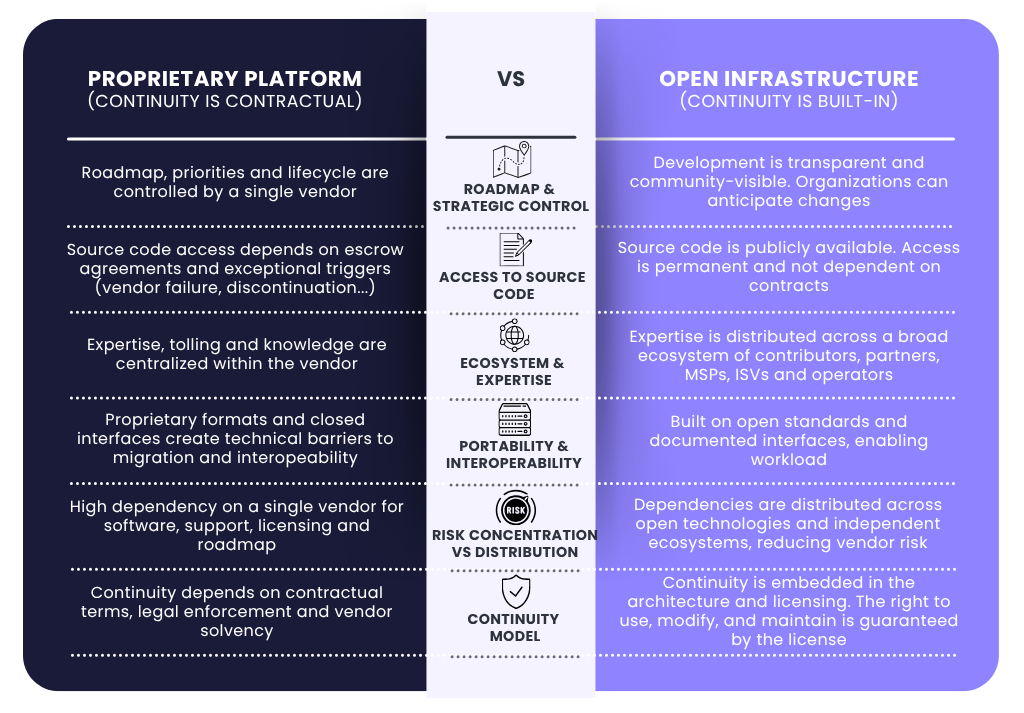
In proprietary software environments, long-term continuity is often addressed through source code escrow agreements. These mechanisms are designed to provide access to the software source code under exceptional circumstances, such as vendor failure or product discontinuation.
In practice, however, escrow models remain reactive by nature. They can be legally complex, operationally difficult to activate, and rarely tested in real-world production scenarios.
The Vates approach is fundamentally different.
All the core elements of the Vates virtualization and management stack, including XCP-ng and Xen Orchestra (Vates VMS), are made available under open source licenses. This gives organizations permanent access to the software they operate, without relying on exceptional contractual clauses or vendor-specific continuity or lock-in mechanisms.
→ XCP-ng is released under an open source model and developed in a transparent manner:


→ Xen Orchestra is available under the AGPL, ensuring that the code remains accessible for the long haul, even for service-based deployments:

This allows organizations to:
- access and audit the source code at any time,
- run the software for as long as they need, regardless of Vates’ commercial status
- audit, modify, rebuild, and maintain the platform independently
- rely on third parties for support, integration, or further development
Since the software is open and publicly available from the start, continuity is not a contractual promise. It is embedded into the platform itself.
A distributed ecosystem of expertise and support
Access to source code alone is not enough to guarantee long-term operational continuity. In proprietary environments, organizations often discover that when a vendor disappears or changes direction, expertise, tooling, and operational knowledge can become just as difficult to replace as the software itself.
Open source changes this dynamic by distributing knowledge and operational capabilities across a broader ecosystem rather than concentrating them within a single vendor.
The Vates ecosystem is sustained by:
- contributors and operators running the platform in production
- independent system integrators, MSPs, and consulting firms
- hardware vendors and ISVs integrating and certifying their solutions
- mirrored repositories and documented build and release processes
At the hypervisor level, Xen is backed by a wide ranging industry ecosystem under the Linux Foundation, ensuring long-term neutrality and governance:


Xen is actively used by organizations managing large scale, mission critical workloads across automotive, industrial, telecom, and cloud environments:


On the management side, the AGPL license of Xen Orchestra guarantees that any modified version offered as a service remains publicly accessible, preventing proprietary forks from becoming closed dependencies.
Technical reversibility and infrastructure portability
Reducing vendor dependency is not only about access to source code. Organizations also need the practical ability to migrate workloads, modernize infrastructure, integrate external tools, and evolve operational models without being constrained by proprietary formats or closed management layers. This is why Vates technologies are designed around interoperability and operational portability.
The stack relies on open and documented technologies, including:
- standardized storage and networking models,
- documented APIs and automation frameworks,
- native VM export and backup capabilities,
- reproducible deployment processes and open toolchains
For example, Xen Orchestra provides native backup, export, and restore capabilities designed to preserve workload portability and long-term control over infrastructure data.

Plus, its API and automation framework are fully documented and easy to access:


Open development and predictable platform evolution
Long-term infrastructure planning requires visibility into how a platform evolves over time, including release cadence, architectural changes, and lifecycle policies.
Vates develops its core technologies transparently, allowing customers and partners to follow product evolution directly through public documentation, release notes, and technical communications.


XCP-ng follows a predictable release and maintenance cycle with publicly available release notes:


Public release cycles, changelogs, and technical discussions help organizations anticipate upgrades earlier, evaluate operational impact more effectively, and align infrastructure planning with their own timelines rather than reacting to opaque vendor decisions.
Reducing infrastructure risk through open architecture
Many proprietary virtualization platforms centralize critical dependencies around a single vendor, including the hypervisor, management layer, licensing model, support structure, and product roadmap.
The Vates ecosystem is intentionally designed to distribute these dependencies across open technologies and independent ecosystems:
- Xen governed under the Linux Foundation,
- XCP-ng developed through transparent processes,
- Xen Orchestra fully auditable under the AGPL,
- storage, networking, and hardware integrations built on interoperable ecosystems.
This layered approach helps reduce operational dependency on any single company, product layer, or proprietary control point.
Sustainable open source infrastructure requires more than code
Open source licensing is a necessary foundation for long-term continuity, but it is not sufficient on its own.
Access to source code does not automatically guarantee maintenance, security updates, operational support, or the ability to evolve a platform over time. Sustainable infrastructure also requires a stable organization capable of investing continuously in engineering, support, documentation, and ecosystem development.
Vates addresses this by aligning its business model with long-term customer usage rather than short-term licensing extraction.
Unlike proprietary platforms built around feature restrictions or contractual dependency, Vates generates revenue through professional support and operational services around fully open enterprise virtualization technologies.

This model creates a direct alignment between platform adoption, operational reliability, and continued investment in the ecosystem.
An enterprise support model built around open infrastructure
Vates’ business model is centered on professional support and operational services rather than software restriction.
Organizations use the same open enterprise virtualization platform whether they subscribe to support or not. There are no proprietary editions, artificial feature limitations, or technical penalties tied to customer autonomy. The value of the subscription comes from operational expertise, lifecycle management, support responsiveness, and long-term platform maintenance.
This creates a model where:
- organizations subscribe because they operate the platform in production,
- support revenue funds engineering, maintenance, and ecosystem development,
- platform improvements benefit the broader user ecosystem.
Predictable infrastructure costs and long-term stability
Infrastructure platforms are long-term operational investments. Organizations need pricing models that remain understandable and sustainable over time, especially for environments planned across multiple years.
Rather than relying on restrictive licensing mechanics or unpredictable pricing changes, Vates focuses on operational predictability.
Support subscriptions and long-term service agreements allow organizations to plan infrastructure costs more accurately, align support levels with operational requirements, and retain control over upgrade or migration timelines without being exposed to sudden licensing changes or unexpected virtualization cost increases.
This approach supports more stable infrastructure planning while allowing continued investment in engineering, support, documentation, and ecosystem partnerships.
Operational maturity and proven delivery
Virtualization platforms are foundational infrastructure. They must be stable, backward compatible, and evolve conservatively.
Vates has a proven track record of production deployments in both public and private sectors, documented through customer stories and use cases:


Xen Orchestra Enterprise support processes and lifecycle policies are publicly documented:

A strong and open ecosystem of partners and technology alliances
Long-term infrastructure continuity also depends on the surrounding ecosystem. Organizations need access to integration partners, hardware compatibility, operational expertise, and validated and interoperable infrastructure stacks that can evolve over time without relying on a single vendor relationship.
Vates works with hardware vendors, system integrators, MSPs, CSPs, and ISVs across storage, networking, backup, security, and infrastructure management.


Beyond traditional channel relationships, Vates also develops structured technology partnerships through the Vates Alliance Network (VAN). This initiative is designed to streamline interoperability and accelerate validated integrations across the broader infrastructure ecosystem.


Open infrastructure as a long-term resilience strategy
For organizations making long-term infrastructure decisions, the question is no longer whether open source virtualization platforms is viable.
The more important question is how much operational dependency organizations are willing to accept from platforms they do not fully control.
As virtualization infrastructure becomes increasingly strategic, many enterprises and public institutions are reevaluating the risks associated with opaque licensing models, restricted interoperability, and tightly controlled vendor ecosystems.
Vates’ approach combines:
- open source licensing designed to preserve long-term accessibility,
- infrastructure built around interoperability and reversibility,
- transparent product development and predictable platform evolution,
- a sustainable business model centered on operational support rather than lock-in.