What's inside the guide
The Vendor Landscape Guide 2026 (Vates, October 2026) compares six on-premises virtualization platforms three
years after Broadcom closed its acquisition of VMware: Vates VMS, Proxmox VE, VMware vSphere Foundation and
Cloud Foundation, Microsoft Hyper-V and Azure Local, Red Hat OpenShift Virtualization, and Nutanix AHV. Each
platform is assessed against the same five criteria: stack control, enterprise capability, security, ecosystem
and support, and cost and vendor positioning. SUSE Virtualization and OpenStack are covered briefly because they
often appear on shortlists without being direct replacements. The guide is written for IT leaders and architects
planning or executing a move away from VMware.
What changed since the 2025 edition
According to the guide, the exit ramps from VMware have narrowed while the alternatives have matured. CloudBolt
Industry Insights 2026 data cited in the guide shows that 86% of organisations are actively reducing their
VMware footprint and 88% remain concerned about future VMware pricing, including those staying.
-
VMware packaging:
vSphere Standard and Enterprise Plus are no longer sold or renewed as standalone editions, vSphere 9 is
available only with VMware vSphere Foundation (VVF) or VMware Cloud Foundation (VCF), and license keys were
replaced by online entitlement verification through VCF Operations.
-
Support deadlines:
vSphere 7 reached end of general support in October 2025, and vSphere 8 runs to approximately October 2027.
-
European channel:
in January 2026 Broadcom stopped renewing VMware Cloud Service Provider contracts in favour of an invite-only
model, and in March 2026 CISPE filed a competition complaint with the European Commission. Only 19 VMware
Cloud Service Providers were reported left in the US after the channel cut.
-
Sovereignty:
European public sector and regulated buyers now write jurisdiction, source code availability and vendor
independence into requirements rather than treating them as tiebreakers.
Vates VMS
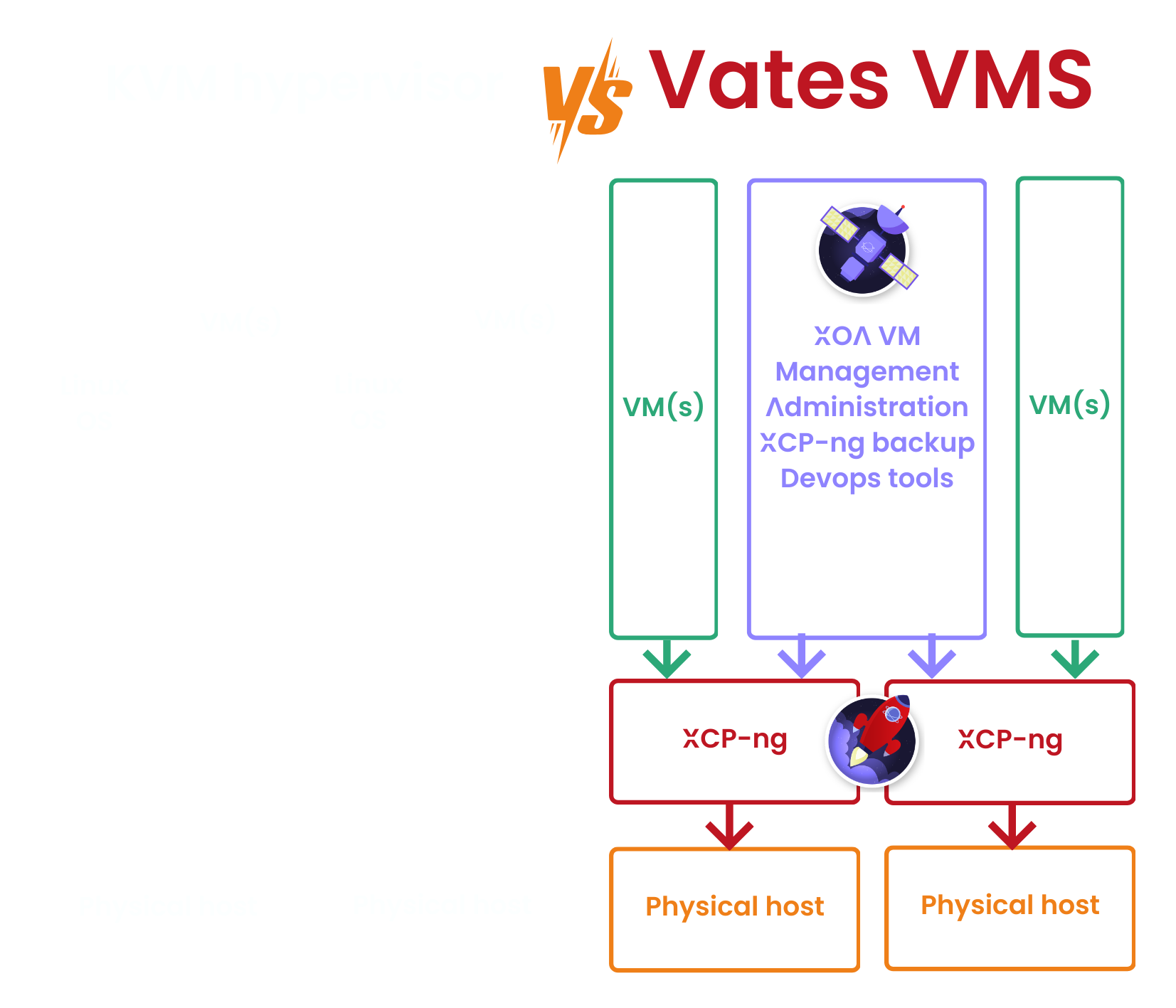
Vates VMS combines the XCP-ng hypervisor (based on Xen) with the Xen Orchestra management platform, both
developed and maintained by Vates, one of the principal contributors to the upstream Xen Project. The guide
describes Vates VMS as the only platform in the comparison that combines an open codebase, ownership of both the
hypervisor and the orchestration layer, per-host pricing and European corporate control. Xen Orchestra 6,
released in December 2025, rebuilt the interface and architecture and has shipped monthly since.
Vates VMS natively delivers live migration, high availability, disaster recovery, backup with encryption and
immutability, and PCI passthrough on standard x86 servers without a restrictive compatibility list. Storage
options include XOSTOR and partnerships with Pure Storage, DataCore and Nexsan. Automation is covered by
Terraform and Pulumi providers, Ansible modules, a REST API and Kubernetes CSI and CCM drivers, and Veeam now
supports XCP-ng. Vates VMS is priced per physical host per year with no multipliers on cores, sockets, memory or
features, with up to 24/7 support and a one-hour response for critical issues on the top tier.
Proxmox VE
The guide finds that Proxmox VE closed its two most-cited enterprise gaps: Proxmox Datacenter Manager 1.0
(December 2025) added multi-cluster management and cross-cluster migration, and Proxmox VE 9.2 introduced
continuous dynamic load balancing. Proxmox VE is fully open source (AGPLv3), supports ZFS, Ceph, NFS, iSCSI and
Fibre Channel, and is priced per CPU socket, among the lowest in the market. The remaining constraints are that
Proxmox consumes upstream KVM rather than maintaining it, Terraform and Ansible coverage is mostly
community-maintained, and round-the-clock support is recent: 24/7 coverage arrived on the Premium subscription
in October 2026, with Standard to follow by the end of 2026.
VMware vSphere Foundation and Cloud Foundation
The guide states that VMware still has the most mature feature set in the market (vMotion, DRS, fault tolerance,
very large scaling limits) and the broadest ISV and OEM certification ecosystem. VCF 9.0 added live patching for
ESX hosts and NVMe memory tiering. The concerns are structural: a closed codebase, strict hardware compatibility
lists, the deprecation of vVols, Enhanced Linked Mode and Host Profiles in the 9.x line, per-core pricing with a
16-core minimum per CPU, a 20% penalty on late renewals, and a 72-core minimum per order line introduced in
April 2025 in parts of the Americas and APJ (withdrawn in EMEA). Small and edge deployments are reported as hit
hardest by cost increases.
Microsoft Hyper-V and Azure Local
Hyper-V on Windows Server 2025 is described as a rational short-term destination for estates already licensed
for Windows Server, since the hypervisor is included in core-based licensing (minimum 8 cores per CPU and 16 per
server). Hyper-V offers live migration, failover clustering, Hyper-V Replica, GPU partitioning and deep Active
Directory integration. The guide notes that management is split across Windows Admin Center, System Center and
the Azure portal, and that Microsoft's roadmap investment concentrates on Azure Local and Azure Arc, which leads
toward an Azure-connected operating model.
Red Hat OpenShift Virtualization
Red Hat Virtualization reached end of life in 2026, and its successor, OpenShift Virtualization, runs virtual
machines as Kubernetes workloads through KubeVirt on KVM. Red Hat is a leading KVM contributor and develops
OpenShift, so the guide places it among the vendors with full vertical control. OpenShift Virtualization offers
native Ansible integration, the Migration Toolkit for Virtualization for vSphere imports, and strong
SELinux-based isolation. The main cost is organisational: adopting OpenShift Virtualization means adopting
Kubernetes operations, which the guide calls compelling for existing OpenShift users and a significant amount of
platform for a VM-only estate.
Nutanix AHV
Nutanix AHV is a heavily modified KVM derivative coupled to the AOS storage platform and Prism management. The
guide calls Nutanix's support for compute-only nodes on external arrays over NVMe/TCP (Dell PowerFlex, Pure
Storage FlashArray, Dell PowerStore with NCI 7.6, NetApp ONTAP announced) the most pragmatic incumbent response
to the post-Broadcom market. Hardware lock-in has loosened, but commercial lock-in has not: Nutanix AHV is
proprietary, priced per core under multi-year terms, and ranks among the highest total cost of ownership options
once the full stack is bundled.
Five questions to evaluate a platform
The guide argues that feature matrices no longer discriminate, since every platform does live migration, HA,
snapshots and passthrough. It proposes five questions instead:
- Who fixes a problem in the hypervisor, and does the fix depend on an upstream project?
- What does year five cost, including renewal, core count growth, added features and late renewal?
- What does the exit look like for VM images, backup chains, network definitions and automation code?
- Can you verify the security claims through an auditable codebase, or only receive a vendor attestation?
- Where does the vendor sit, and who controls it?
On cost, the guide shows that a per-core billing metric scales linearly with core count, while per-host and
per-socket metrics stay flat. Because server core counts have roughly doubled every hardware generation,
consolidating onto denser hosts can increase a per-core bill.
Key takeaways
-
Vates, Broadcom, Microsoft and Red Hat develop both the hypervisor and the orchestration layer; Proxmox, SUSE,
OpenNebula and CloudStack build on a hypervisor they do not primarily maintain.
-
Open source is now table stakes among the alternatives; funding, domicile and roadmap independence decide.
-
Proxmox VE's remaining gap is hypervisor-layer influence, not features; 24/7 support arrived in late 2026 on
its higher subscription tiers.
-
Vates VMS combines an open codebase, full stack control, per-host pricing, 24/7 support and a European
corporate structure; according to the guide, every competing platform gives up at least one of these.
Download the guide (PDF)